

Xi asks Trump if US and China can avoid 'Thucydides Trap' in Beijing
Xi Jinping asked Trump in Beijing whether the US and China can avoid the 'Thucydides Trap' at a summit that began May 14, 2026; it will last two days.
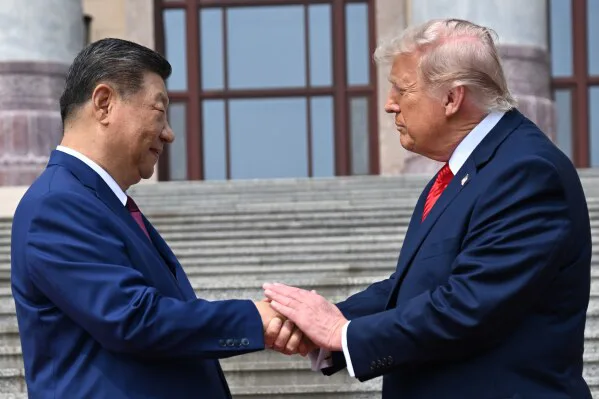
Chinese President Xi Jinping posed a pointed question to U.S. President Donald Trump at the opening of their summit in Beijing on May 14, 2026, asking whether the United States and China can transcend the so‑called "Thucydides Trap." The meeting began with ceremonial proceedings and bilateral talks scheduled across a two‑day agenda.
Officials said the leaders held a roughly two‑hour closed‑door session where trade, technology transfers, Taiwan and the conflict in the Middle East were discussed. The U.S. delegation included business executives, underscoring Washington's push for commercial deals such as increased agricultural purchases and potential aircraft orders that could be presented as deliverables. Chinese state media and Western outlets offered differing emphases on tone and detail.
Markets reacted cautiously, with Asian equities broadly mixed as AI‑related technology stocks supported regional gains while risk‑sensitive sectors lagged. U.S. futures showed modest gains ahead of the full market open and gold edged higher as traders weighed geopolitical and geopolitical‑driven safe‑haven demand. Overall, the immediate market response was muted pending concrete policy outcomes or transactional announcements.
Beyond immediate price moves, the summit highlights structural risks in U.S.‑China relations that matter for global supply chains and strategic industries. Taiwan remains a focal point for market concern because of its central role in semiconductor supply, and any escalation could have material effects on chipmakers and downstream technology firms. Observers note that while symbolism can ease tensions, durable resolutions depend on technical agreements and enforcement mechanisms.
Market strategists view the summit as an opportunity to reduce near‑term policy uncertainty but caution against expecting sweeping breakthroughs. Short‑term trading will likely be driven by announcements on trade commitments, export controls and any US‑China arrangements on technology barriers. For investors, proceeding with scenario‑based positioning—monitoring sector exposure to semiconductors, defence‑sensitive supply chains and currency volatility—remains the prudent approach until concrete accords are published.
💸 Ready to act on this news?
You need a brokerage account to invest. Compare 30+ trusted brokers in seconds — zero commission options available.
Comments (0)
No comments yet. Be the first to comment!