

South Korea's KOSPI Rallies: How Long Will the Bull Market Last?
South Korea's KOSPI index rebounded from its recent rout, re-entering bull-market territory. Renewed investor interest in the index's dominant semiconductor giants drove the surge.
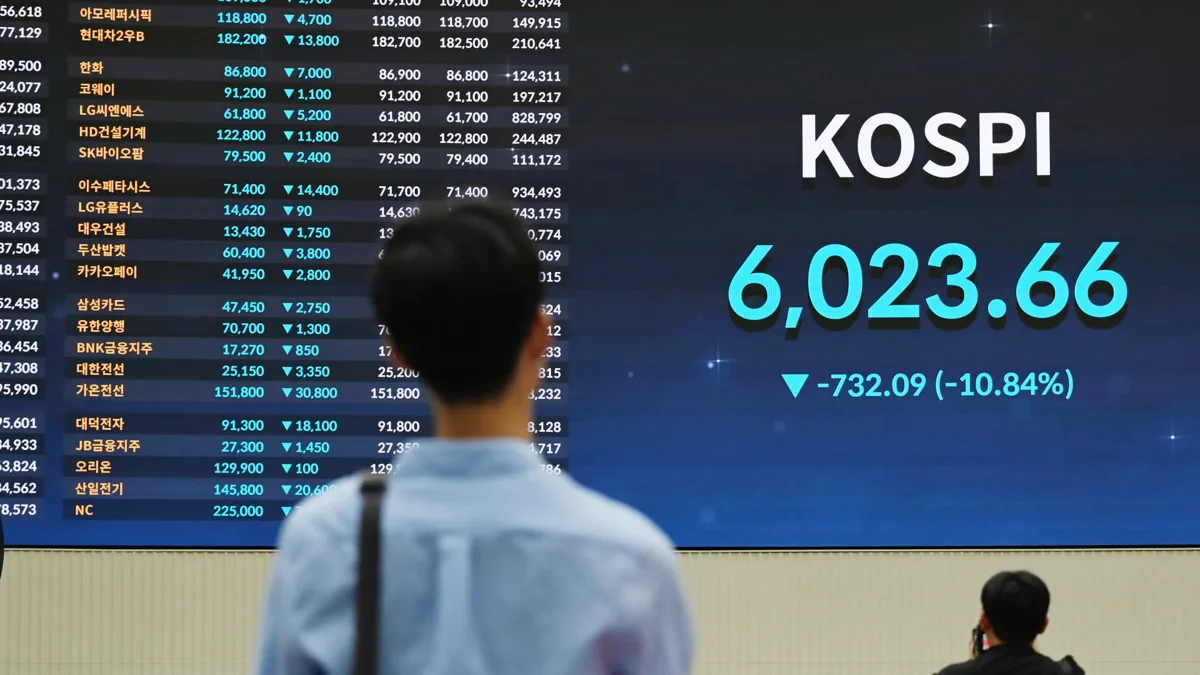
South Korea's benchmark KOSPI index has staged a robust comeback after a brutal sell-off in July, officially entering bull-market territory. Intense investor interest in semiconductor giants like Samsung Electronics and SK Hynix played a pivotal role in the index's more than 30% gain over the past month. This rapid rebound underscores the sustained demand for global artificial intelligence (AI) technologies and renewed market confidence in chip manufacturers.
The index had plunged into bear market territory in July 2026, experiencing its worst month since the 2008 global financial crisis with a 22% decline. This downturn was largely driven by concerns over stretched AI-related stock valuations, leverage liquidations, and a broader global semiconductor sell-off. However, the KOSPI rebounded between 22% and 30% from its July 30 low, reaching 6,813.34 points as of August 13, 2026. Shares of major companies such as Samsung Electronics (005930.KS) and SK Hynix (000660.KS) achieved significant gains, fueled by escalating demand for AI chips, particularly high-bandwidth memory (HBM).
This rally was further bolstered by slowing growth in the U.S. Consumer Price Index (CPI) and expectations for a Federal Reserve (Fed) interest rate cut in September. Strong buying activity from foreign and institutional investors in the South Korean market also accelerated the index's momentum. Robust second-quarter 2026 earnings reports and optimistic future guidance from Samsung Electronics and SK Hynix solidified investor confidence. On August 13, 2026, Samsung Electronics' shares surged by 4.89%, while SK Hynix's skyrocketed by 5.92%.
The South Korean economy is currently experiencing a broad-based, semiconductor-led recovery. According to reports from the Korea Development Institute (KDI), July exports surged by 62.8% year-on-year, with information and communications technology (ICT) products, especially semiconductors, seeing an extraordinary increase of 178.2%. In 2024, the semiconductor sector became the country's largest manufacturing industry, accounting for over 10% of its total manufacturing output. This highlights how investments in AI infrastructure since late 2022 have reshaped the global chip supply chain. Nevertheless, uncertainties persist, including U.S. tariff measures, instability in the Middle East, and sluggish construction investment.
Market analysts emphasize that the KOSPI's rapid recovery highlights the inherent volatility of tech stocks and raises questions about the sustainability of the current rally. For the uptrend to continue, fundamental indicators such as sustained strong demand in AI infrastructure spending, ongoing need for advanced memory chips, and healthy chip pricing must remain robust. The earnings and future outlook of Samsung Electronics and SK Hynix are crucial for assessing the health of the memory market. While some analysts anticipate memory supply shortages to persist until 2028 due to AI-driven demand, the index's reliance on a few semiconductor companies leaves the market vulnerable to fluctuations in AI market sentiment. Experts generally foresee the upward trend continuing, though the pace of growth may decelerate, leading to increased volatility.
💸 Ready to act on this news?
You need a brokerage account to invest. Compare 30+ trusted brokers in seconds — zero commission options available.
Comments (0)
No comments yet. Be the first to comment!