

CFTC sues four states over prediction markets; RWAs hit $30B
CFTC filed federal suits against four states over prediction markets; tokenized real‑world assets’ on‑chain distributed value topped $30 billion in April.
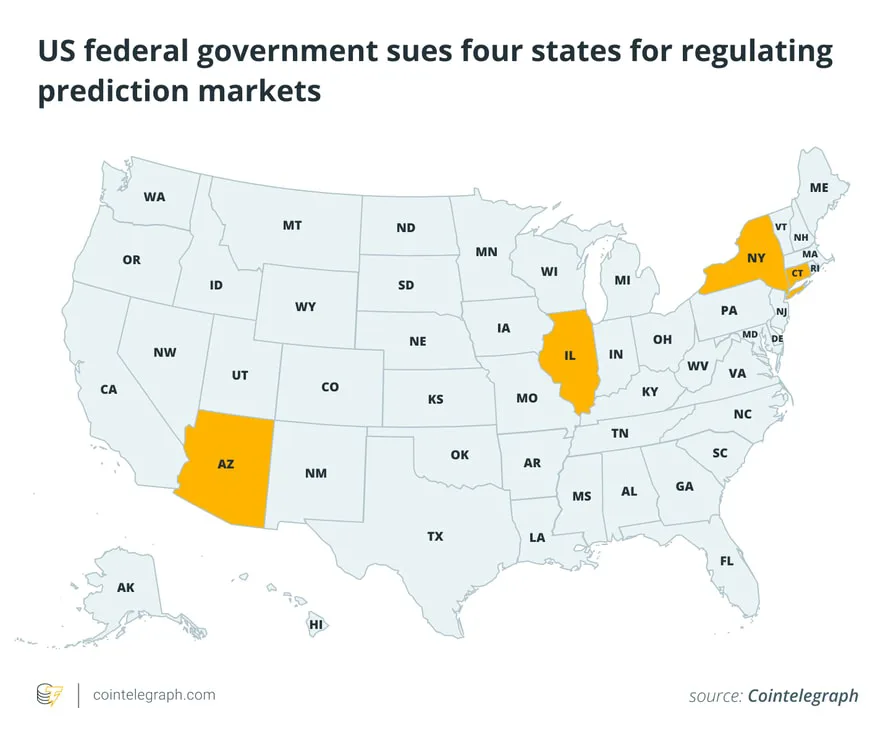
The U.S. Commodity Futures Trading Commission (CFTC) has filed federal lawsuits against New York, Connecticut, Arizona and Illinois, arguing that state attempts to apply gambling laws to CFTC‑registered prediction markets encroach on the agency’s exclusive jurisdiction; at the same time, tokenized real‑world assets (RWAs) continued rapid growth on‑chain.
The litigation timeline is compact: the CFTC and Department of Justice initiated suits in early April against Arizona, Connecticut and Illinois and expanded action to New York on April 24, 2026, after state regulators and attorneys general moved against platforms such as Kalshi and Polymarket. The agency’s filings seek declaratory relief that federal derivatives law preempts inconsistent state regulation, a question that has already produced divergent appellate rulings and could ultimately reach the U.S. Supreme Court.
In parallel market news, Strategy Inc. disclosed in a Form 8‑K that it sold 1,451,601 shares of its Class A common stock (MSTR) under its at‑the‑market offering between April 20 and April 26, 2026, raising net proceeds of $255.0 million and using the funds to acquire 3,273 BTC. The filing reported aggregate holdings of 818,334 BTC as of April 26, with accompanying cost‑basis metrics. These corporate treasury maneuvers highlight how public equity issuance remains a capital channel for large corporate Bitcoin accumulation.
From a market perspective, the legal showdown over prediction markets introduces regulatory uncertainty that could influence retail access, state tax revenues from sports betting substitutes, and exchange compliance costs. Meanwhile, RWA metrics—tracked across industry dashboards—show distributed asset value climbing toward and through the high‑twenty billions, reflecting institutional tokenization of treasuries, money‑market exposures and private‑credit products. Greater on‑chain RWA distribution tends to compress liquidity spreads and facilitate DeFi collateral use, altering short‑term price dynamics across fixed‑income‑like token products.
Looking ahead, legal outcomes will be the key variable: a decisive federal ruling in favor of the CFTC would preserve a uniform national framework for event contracts, while split decisions would prolong fragmentation and state enforcement actions. For markets, continued RWA growth suggests an intensifying institutional footprint on public blockchains, and Strategy’s ongoing ATM‑funded buys imply potential for further corporate treasury accumulation—factors traders and regulators alike will monitor closely.

Related Symbols
₿ Want to ride this crypto move?
Open an account in minutes. Compare brokers offering crypto and start investing today — zero commission options available.
Comments (0)
No comments yet. Be the first to comment!