

Bitcoin Slides as US Inflation Fails to Spark Rally, ETFs See Increased Outflows
Spot Bitcoin exchange-traded funds (ETFs) recorded their first back-to-back days of outflows in August. The largest cryptocurrency erased last week's gains, while altcoins struggled to find direction amidst a broader market downturn.
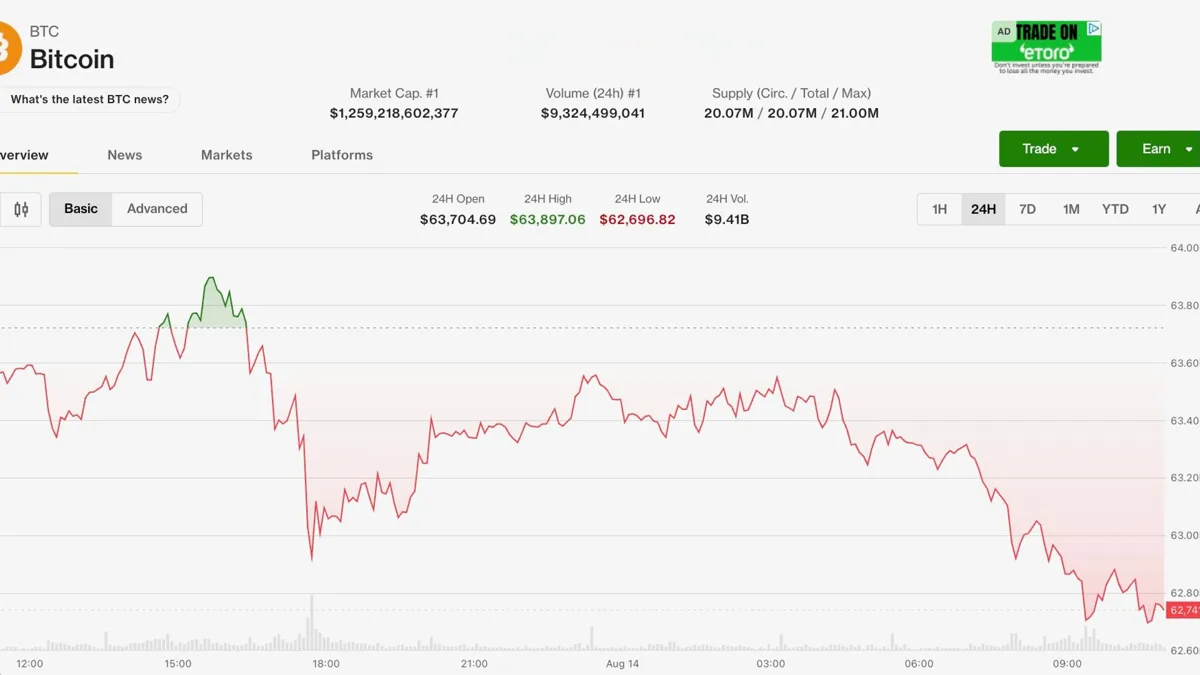
Bitcoin experienced a decline as US inflation data failed to stimulate the market, coupled with ongoing outflows from spot exchange-traded funds (ETFs). Spot Bitcoin ETFs recorded net outflows for two consecutive days in August for the first time, signaling a decrease in investor risk appetite. This development led Bitcoin to shed its gains from the previous week and fall below the $63,000 level.
The US Bureau of Labor Statistics announced the July Consumer Price Index (CPI) data on August 12, which came in largely in line with expectations at 3.4% year-over-year. Core inflation, excluding volatile food and energy components, was recorded at 0.2% month-over-month and 2.5% year-over-year. While these figures eased immediate tightening pressure on the Federal Reserve's (Fed) monetary policy, they failed to trigger a significant rally in the markets. Separately, Producer Price Index (PPI) data cooled to 4.7%, falling below forecasts, leading to a limited uptick in US equity markets.
Outflows from spot Bitcoin ETFs amounted to approximately $192 million over two days, with $131.1 million on August 13 and $61.1 million on August 12. The total weekly outflow exceeded $332 million. Notably, ARK 21Shares' ARKB fund saw the largest outflows at $58.8 million, followed by Fidelity's FBTC fund with $55.1 million. Grayscale's GBTC fund also recorded substantial outflows, while Grayscale Bitcoin Mini Trust and Morgan Stanley's MSBT fund saw modest inflows. These outflows contributed to Bitcoin's struggle to maintain its previous rallies above $65,000, pushing its price into a consolidation zone around $63,000.
The US inflation data meeting expectations suggested that market participants had already priced in this outcome. While a decline in inflation typically creates a favorable environment for risk assets, the pre-emptive pricing prevented a significant rally in Bitcoin this time. Furthermore, the CPI remaining above the Fed's 2% inflation target dampened expectations for a rate cut at the upcoming September Fed meeting. This reinforced the perception that borrowing costs would not decrease and investor risk appetite would not significantly increase, thereby exerting pressure on Bitcoin.
Market analysts note that Bitcoin has largely traded within a range of $62,000 to $66,000 in recent weeks, struggling to break out of this range. Institutional demand is competing with sales from miners and corporate holders, while trading volume and implied volatility have also declined. Moving forward, macroeconomic indicators such as the Fed's Jackson Hole meeting and ETF flow dynamics will play a critical role in determining the short-term direction of cryptocurrency markets. In the long term, institutional adoption and regulatory developments are expected to influence market trends.
Related Symbols
₿ Want to ride this crypto move?
Open an account in minutes. Compare brokers offering crypto and start investing today — zero commission options available.
Comments (0)
No comments yet. Be the first to comment!