

APEC calls for cooperation as China envoy leads opening; minister absent
APEC trade ministers met in Suzhou on May 22, 2026. China’s trade envoy Li Chenggang opened the session while Minister Wang Wentao was reported absent due to "urgent official business".
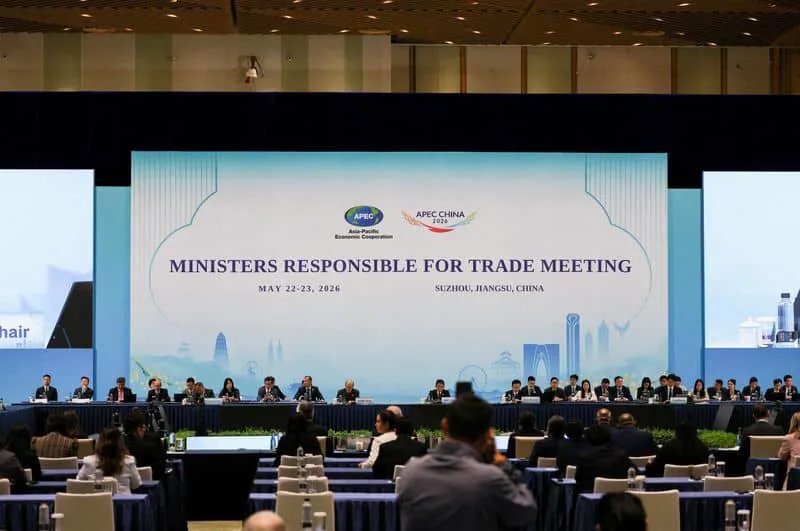
Trade ministers from APEC economies convened in Suzhou on May 22, 2026, where China’s international trade representative and vice commerce minister Li Chenggang delivered the opening remarks urging stronger regional cooperation. Li called on member economies to send a unified message in favor of open trade and resilient supply chains, stressing the need for consensus amid growing global uncertainty. Reuters reported Li’s address and the meeting’s focus on digital trade, supply chain connectivity and institutional reform.
Several outlets, citing CNBC, reported that Commerce Minister Wang Wentao did not attend the opening session due to what was described as "urgent official business." Reuters' coverage confirmed Li's role in the opening and highlighted remarks from the APEC Business Advisory Council chair Li Fanrong, who urged a pause on new trade restrictions to avoid further uncertainty for business and investment.
The timing of the meeting is significant: Reuters noted it follows China’s record trade surplus of nearly $1.2 trillion last year and comes shortly after a series of high-level visits, including the recent Trump-Xi summit in Beijing. Policymakers and market participants will watch whether the Suzhou talks translate into concrete commitments on market access, digital trade rules and supply-chain resilience—areas that can influence trade flows and investment decisions across Asia-Pacific markets.
From a market perspective, the immediate impact is likely to be muted unless the ministers produce explicit, binding measures or clear bilateral agreements. Nonetheless, announcements or signals on reducing trade frictions, coordinated supply-chain initiatives or infrastructure commitments could affect sectors tied to global trade—manufacturing, logistics and certain commodity markets—by altering demand expectations.
Analysts say the key items to monitor are the final joint communiqué, any agreed technical working groups on digital trade and supply chains, and follow-up bilateral talks. Investors will also track official statements from China’s Ministry of Commerce for clarification about Minister Wang’s schedule and any substantive directives resulting from the Suzhou meeting. In the short term, market participants expect an emphasis on diplomacy and procedural cooperation, with concrete trade measures depending on subsequent negotiations and implementation steps.
💸 Ready to act on this news?
You need a brokerage account to invest. Compare 30+ trusted brokers in seconds — zero commission options available.
Comments (0)
No comments yet. Be the first to comment!